

ExtractoDAO Releases DUT Viscoelastic Continuum Creation Module for Cosmological Analysis
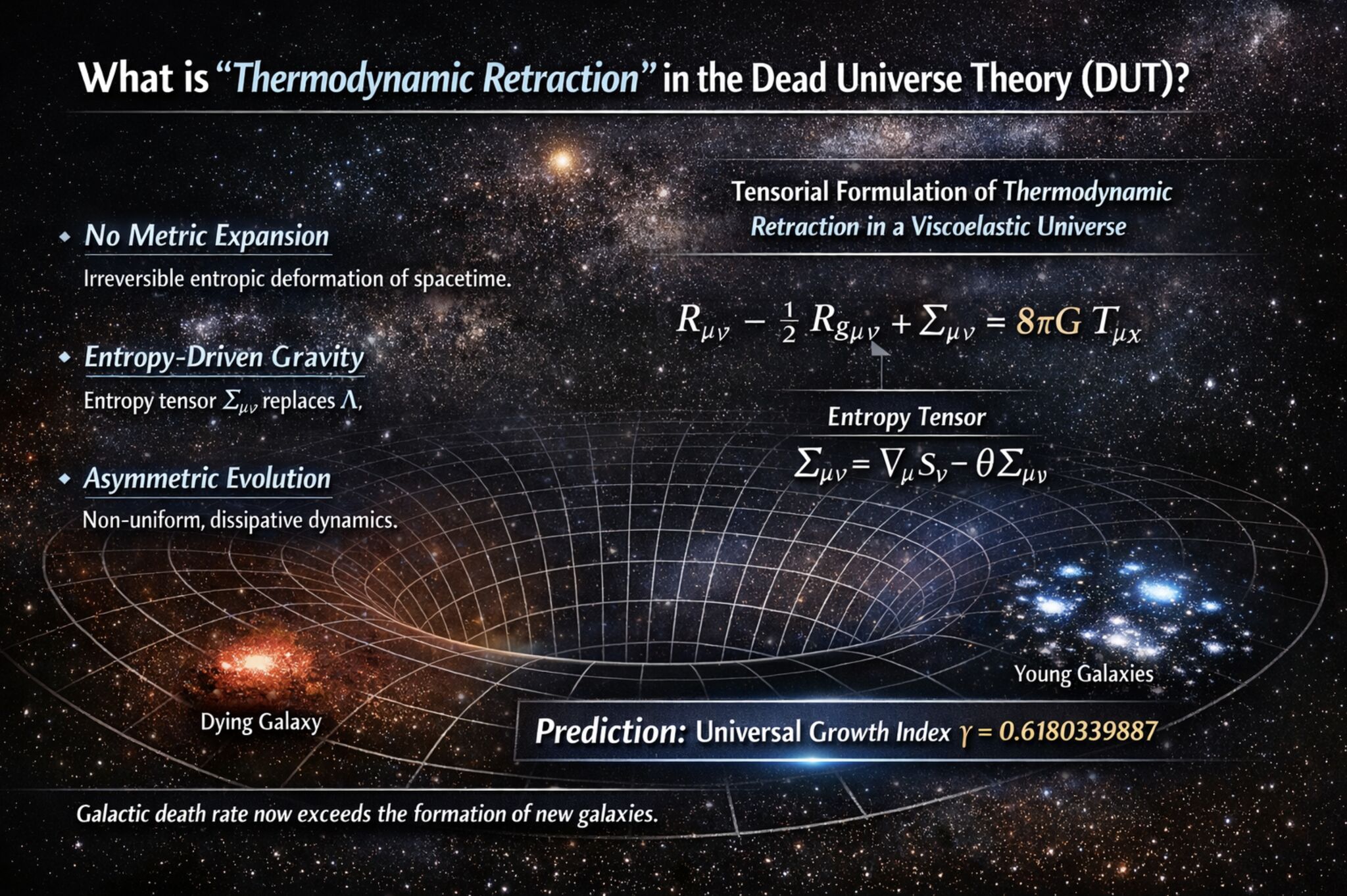
The universe as a viscoelastic continuum explains cosmic evolution via quantum decoherence, not inflation, with predictions testable by Euclid (2027-2030).
CURITIBA, PARANá, BRAZIL, February 1, 2026 /EINPresswire.com/ -- ExtractoDAO Releases DUT Viscoelastic Continuum Creation Module for Cosmological Analysis
New computational module models quantum decoherence as the origin of a cold viscoelastic substrate, enabling testable predictions for Euclid, DESI, and next-generation surveys
Hong Hong/Curitiba, Brazil — 01/02/2025
ExtractoDAO Labs has released a new scientific computing module for the international cosmology and astrophysics community:
“Creation of the Viscoelastic Continuum (DUT): Quantum Decoherence as the Origin of the Dead Substrate.”
The module is part of the Dead Universe Theory (DUT) framework and delivers a mission-grade, reproducible simulation engine designed to model the emergence of the observable universe from a cold, non-singular viscoelastic substrate, without invoking cosmic inflation or adjustable dark-energy components.
Developed in Fortran and Python, with HCNI (Halt Condition on Numerical Instability) safeguards and full numerical traceability, the module supports precision interpretation of data from Euclid, DESI, JWST, and the Nancy Grace Roman Space Telescope.
What the Module Simulates
The DUT Continuum Creation Module simulates the quantum-to-classical transition of spacetime through self-induced quantum decoherence, generating:
A cold, viscoelastic gravitational substrate (“dead continuum”)
Emergence of a structural entropic deformation tensor
Irreversible thermodynamic retraction without metric expansion
Conditions for structure formation, redshift, and late-time cosmic dynamics
The model does not assume a hot, dense initial singularity, nor does it rely on inflation. Instead, it describes the observable universe as a structural phase emerging within an already-existing cold continuum, fully consistent with relativistic covariance and non-equilibrium thermodynamics.
Key Outputs and Scientific Products
The module produces:
Background evolution functions E(z) and D(z)
Structure growth observables f(z) and fσ8(z)
Physical redshift derived from cumulative entropic deformation, not space stretching
Phase-space stability analysis of growth equations
Automated falsification scoring integrated into DUT Quantum and DUT-RG simulators
A central, non-adjustable prediction of the model is the growth index:
gamma = 0.6180339887
This value arises as the unique stable fixed point of the late-time growth dynamics under minimum entropy production and stability conditions.
It is not fitted, not approximated, and not tunable.
Euclid and DESI: A Clear Falsification Line
The DUT framework establishes a sharp observational test:
If high-precision surveys converge to
gamma ≈ 0.55 (the General Relativity / LambdaCDM prediction),
the DUT growth mechanism is refuted.
If convergence occurs toward
gamma = 0.6180339887,
Article: https://zenodo.org/records/18448863
it supports the presence of a thermodynamic vacuum attractor, as predicted by DUT.
Upcoming Euclid growth measurements and DESI clustering analyses therefore provide a decisive empirical test.
Scientific Statements
Joel Almeida, Founder and Scientific Director of ExtractoDAO, stated:
“This module replaces assumptions with equations. DUT makes fixed predictions, exposes them to falsification, and accepts the outcome. That is how science progresses.”
Eduardo Rodrigues, Computational Physics Lead at ExtractoDAO, added:
“Numerical integrity was a priority. HCNI safeguards, deterministic solvers, and full traceability prevent hidden instabilities or parameter drift.”
Rosbon Miranda, Modeling Advisor, commented:
“The strength of this technology is practical. It allows cosmologists to test a non-inflationary, non-singular scenario using the same observables they already trust—growth, distances, and redshift.”
Availability and Integration
Core solvers: Fortran
Analysis and inference: Python
Compatibility: Euclid, DESI, CMB, BAO, SNe, LSS pipelines
Numerical integrity: HCNI, reproducible builds, cryptographic logs
Status: Public scientific release via the DUT-CMB Scientific Engine v3.
https://github.com/ExtractoDAO/DUT-CMB-Scientific-Engine-3.0-NASA-ESA-Production-Grade
About ExtractoDAO Labs
ExtractoDAO Labs is a deep-tech scientific research company focused on computational cosmology, thermodynamic gravity, and open, auditable scientific infrastructure. Its mission is to provide reproducible scientific engines where theories are tested by data, not protected by parameter tuning.
Eduardo Rodrigues
ExtractoDAO Labs
email us here
Visit us on social media:
LinkedIn
YouTube
ExtractoDAO Releases DUT Viscoelastic Continuum
Legal Disclaimer:
EIN Presswire provides this news content "as is" without warranty of any kind. We do not accept any responsibility or liability for the accuracy, content, images, videos, licenses, completeness, legality, or reliability of the information contained in this article. If you have any complaints or copyright issues related to this article, kindly contact the author above.
